
Respirator White Card Lamination Box + Barcode Label Solution for a Medical Device Company
Client Requirements
Client Requirements and Issues with the Original Solution
The client's existing packaging had two prominent issues.
First, the box lacked sufficient strength.
Respirator products carry some self-weight, and lower-tier packages were crushed and deformed during stacked storage.
Second, the packaging lacked compliant medical-device product markings and barcode information.
This affected end-line identification and traceability.
The company planned an upgrade of the packaging.
The first batch was not large, and they wanted to confirm the solution through sample proofing before bulk production.
Core requirements: structural strength + compliant markings + small-batch sample confirmation.
Project challenges:
✓ Respirator products carry some self-weight, single-layer paperboard boxes deform easily
✓ Compliant medical-device markings and barcodes need to be added
✓ Small first-batch quantity makes traditional plate-making proofing expensive
✓ Subsequent bulk production must switch to offset printing to lower unit cost
Solution
Solution Overview
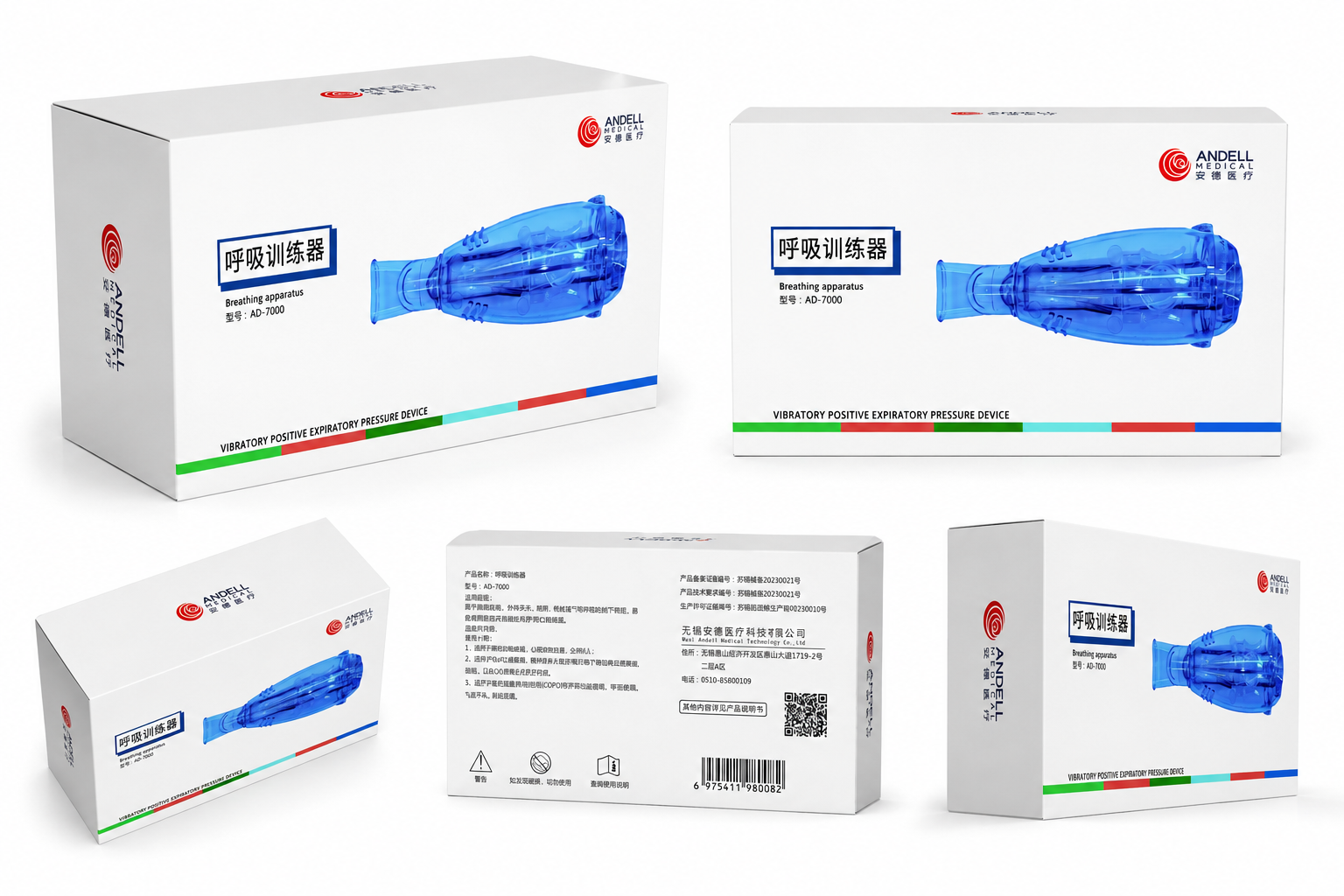
Provided the client with an integrated white-card laminated box + dual-label solution for 3 respirator models.
The color box uses a 350g white-card paper laminated structure to enhance compression strength.
After lamination, stiffness approaches that of single-layer 700g paperboard.
The identification label and barcode label respectively serve product identification and scanning-into-warehouse functions.
The complete solution is produced one-stop by LeXiang Packaging.
Material Selection Analysis
Why 350g white-card paper lamination?
After lamination the box is stiffer, and compression performance exceeds single-layer paperboard of the same grammage.
After lamination, 350g white-card stiffness approaches that of single-layer 700g paperboard.
Respirator products have relatively high self-weight, so stacked storage requires sufficient box compression performance.
Why not single-layer 350g white card?
Single-layer 350g white card has limited stiffness.
Two of the three models have products weighing more than 1kg.
Bottom-tier boxes tend to develop crush marks and deformation during stacked storage.
Why not corrugated boxes?
Corrugated boxes offer better compression performance.
But surface print precision is inferior to white-card paper, and the corrugated texture affects brand-color rendering.
The respirator color box is positioned for end-line display.
Production Implementation and Quality Control
① Size and artwork files organized for the 3 models
② White-card paper lamination (lamination pressure and temperature control)
③ Four-color printing
④ Matte film lamination (25μ)
⑤ Die-cutting (including waste stripping)
⑥ Creasing and forming (crease stiffness control)
⑦ Sampling inspection (box compression, lamination bond, print color difference, label adhesion)
⑧ Sorted by model with error-prevention labels, then shipped
Results
Project Results
Delivery Data
✓ Products delivered: 3 respirator model color boxes + product identification labels + barcode labels
✓ Color box material: 350g white-card paper lamination (stiffness approaching single-layer 700g)
✓ Label material: paper-based self-adhesive + matte film 25μ
✓ Printing method: four-color printing
✓ Quantity delivered: 3 models, total 600 sets of color boxes + matching labels
✓ Lead time: 4 working days
Usage Performance
✓ Client feedback: new batch color boxes meet stacked-storage compression requirements
✓ Product identification and barcode labels bond firmly
✓ Unified brand visual style across the 3 models
Case Summary
For medical-device color boxes with non-trivial self-weight.
Box compression strength and appearance quality often need to be delivered together.
This case delivered an integrated white-card laminated box + dual-label solution for 3 respirator models of a medical-device company.
The 350g white-card paper laminated structure boosts stiffness.
The labels respectively serve product identification and scanning-into-warehouse functions.
LeXiang Packaging Experience
Applicable scenarios: medical-device color boxes with non-trivial self-weight. Mid-sized devices requiring stacked storage and long-distance transport. Products with high box-compression requirements.
Material recommendations: 1-2kg self-weight medical devices — choose 350g white-card lamination. 2-3kg self-weight — upgrade to 400g lamination. Heavy equipment — recommend corrugated color boxes.
Non-applicable scenarios: not suitable for scenarios requiring sterile barriers. Sterile barriers belong to a different validation system. Also not suitable for inner packaging in direct contact with the human body.
Notes: medical-device markings and barcodes must comply with applicable regulatory requirements. After white-card lamination the finished thickness increases, so structural design should reserve clearance. Confirm with first-batch proofing before switching to offset printing for bulk production.
Why Choose LeXiang Packaging
✓ One-stop delivery of medical consumable color boxes plus dual barcode labels
✓ White-card laminated box stiffness meets the 350g double-layer standard, single-box load-bearing ≥0.6kg
✓ Dual barcode labels laid out independently per the client's coding rules
✓ Medical consumable markings reviewed for compliance against applicable regulations
Why Choose LeXiang Packaging
✓ One-stop delivery of medical consumable color boxes plus dual barcode labels
✓ White-card laminated box stiffness meets the 350g double-layer standard, single-box load-bearing ≥0.6kg
✓ Dual barcode labels laid out independently per the client's coding rules
✓ Medical consumable markings reviewed for compliance against applicable regulations
Related Reading
Industry-related (by material/process similarity):
A medical-device company: multi-spec color boxes + ...
A medical-device company: stapler staple-cartridge assembly ...
A medical-device company: multi-SKU medical ...
A medical-device company: product label customization ...
A medical-device and industrial client: color box with ...
Project Metrics
Project Overview
Industry: Healthcare (respiratory devices)
Product: Respirator color boxes + product identification labels + barcode labels
Quantity: 3 models, total 600 sets | Variants: 3 respirator models
Material: White-card laminated box (350g × 2) + paper-based self-adhesive labels
Process: Four-color printing, matte film lamination, die-cutting, creasing
Lead time: 4 working days (after artwork confirmation)
Client Background and Application Scenario
A medical-device company produces a home-respirator product line.
The products carry non-trivial self-weight, and transport and stacked-storage scenarios place high demands on packaging compression strength.
Products require matching color boxes as outer packaging when leaving the factory.
The color-box surface needs product identification labels and barcode labels affixed.
The barcode labels support factory-out scanning-into-warehouse and end-line traceability.
The company planned an upgrade of the existing packaging to fit new-product launch needs.
📸 📸 Results Gallery
FAQ
What are the material requirements for medical device packaging boxes?
Non-sterile medical device outer packaging commonly uses white card paper, laminated paperboard, and corrugated paper. White card paper offers excellent printing effects for display, laminated paperboard has high stiffness for heavier products, and corrugated is suitable for transport protection scenarios.
What is the minimum order quantity for white card paper lamination boxes?
The digital sampling stage has a minimum order of 50-100 units. After confirmation, switching to offset printing for mass production can reduce the unit cost.
What are the common box style designs for lamination boxes?
Common box styles include crash-bottom boxes, double insert boxes, self-locking boxes, and lid-and-base boxes. The specific choice depends on product dimensions and opening method.
Are there adhesion requirements for labels on medical device color boxes?
Label adhesion must be evaluated through a 24-hour static adhesion test after application. It is recommended to apply labels only after ensuring the surface is clean and dry.
What information should be included on medical device identification labels?
Typically includes product name, specifications and model, production batch number, registrant information, etc. The specific content is subject to the layout confirmed by the client's regulatory team.
What is the typical lead time for medical device color boxes?
Sampling stage takes 3-5 working days. Mass production takes 5-7 working days. The specific cycle depends on the number of models and process complexity.
Do respirator packaging boxes need to meet sterilization requirements?
The outer packaging color box itself does not directly contact the sterile barrier. The specific sterilization compatibility is subject to the sterilization method and validation report confirmed by the registrant.
Is there a large cost difference between white card paper lamination boxes and single-layer white card boxes?
The lamination process adds a bonding step, making the per-box cost slightly higher than single-layer. However, stiffness and display quality are significantly improved, making it widely used for mid-to-high-end medical device packaging.
How is compressive testing performed for respirator packaging boxes?
Typically evaluated against transport packaging testing standards such as GB/T 4857.4 or ISTA 1A. The specific testing plan is jointly confirmed by the client and the certification body.
What is the difference between medical device barcode labels and identification labels?
Identification labels handle product identification functions. Barcode labels handle scan-in warehousing and end traceability functions. The two are usually designed separately.
Need a Similar Packaging Solution?
Provide product info and packaging needs for a custom solution