
Multi-Specification Color Box + Identification Label Compliant Packaging Solution for a Medical Device Company
Client Requirements
Client Requirements and Issues with the Original Solution
The client's previous packaging solution had three problems.
First, single-layer paperboard had insufficient stiffness. During transport and warehousing the box body would deform, hurting the product image.
Second, the brand standard colors were PANTONE spot colors. Standard four-color printing produced noticeable color variation between batches — when different batches were placed side by side, the color difference was obvious.
Third, product specifications were diverse. Each model had different dimensions and required a corresponding packaging version, yet the brand visual style had to stay consistent.
The client wanted packaging that was rigid and resistant to deformation overall, with pure and vibrant print colors.
High consistency of brand standard colors, and support for follow-up product line extension.
Core requirements: product protection + accurate brand-color reproduction + multi-SKU unified management.
Project challenges:
✓ Initial batch quantity was small, traditional plate-making cost took too high a share
✓ Product specifications were diverse, each model required a different packaging version
✓ PANTONE spot-color batch-to-batch color difference control was strictly demanding
✓ Medical device labeling had to meet regulatory requirements for legibility and durability
Solution
Solution Overview
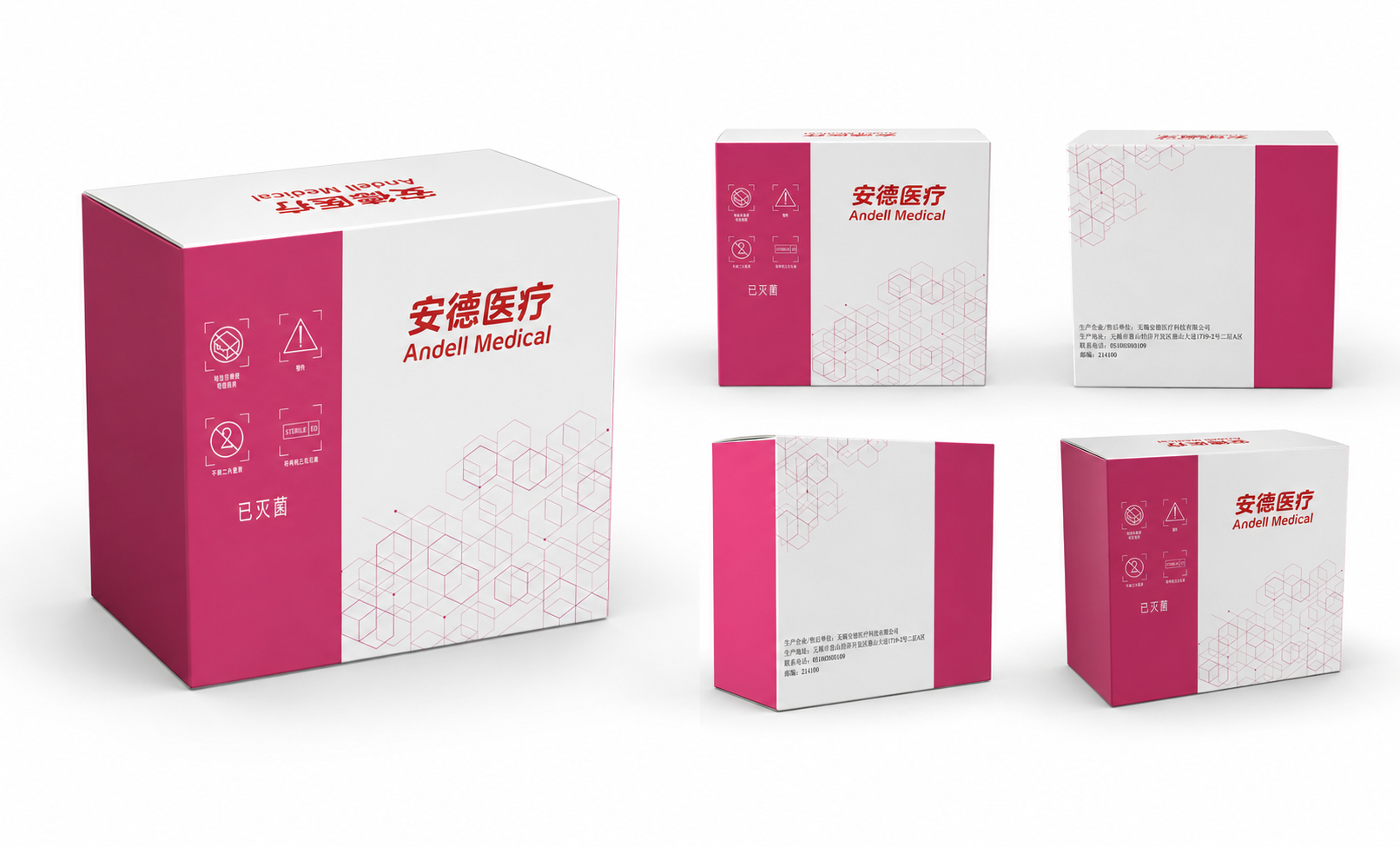
Delivered an integrated color-box + label custom solution for the client's 6-SKU medical device line. The color boxes use a 350g white-card laminated structure to boost stiffness, paired with PANTONE spot-color printing for color-difference control. The identification labels use paper-based self-adhesive stock with matte film lamination for durability and legibility. The whole package is produced by LeXiang Packaging under one roof, avoiding the version-management risk that comes with multi-supplier coordination.
Material Selection Analysis
Why 350g white-card laminated?
After lamination the box body becomes more rigid, with compressive performance superior to single-layer paperboard of equivalent grammage. 350g white-card laminated stiffness approaches that of 700g single-layer paperboard, while surface flatness and print effect remain unaffected. Medical-device color boxes in warehousing stacks have a high requirement for box-body compression resistance.
Why not single-layer 350g white card?
Single-layer 350g white card has limited stiffness. Three of the six SKUs have products weighing over 300g. In warehousing stacks the bottom-layer boxes are prone to compression marks and deformation. The client wanted the packaging to arrive at the end customer still holding a crisp appearance.
Why not corrugated cartons?
Corrugated cartons have better compression resistance, but surface print accuracy is inferior to white card, and the corrugated texture affects how the brand color comes across. Medical-device color boxes are positioned for end-display use — the print quality of white card paper better fits the brand positioning.
Production Implementation and Quality Control
① Dimensional and layout file organization for each SKU
② PANTONE spot-color ink pre-mixing and color-sample comparison
③ White-card lamination (control of lamination pressure and temperature)
④ Four-color + spot-color printing
⑤ Matte-film lamination (25μ)
⑥ Die-cutting (including waste stripping)
⑦ Sampling inspection (box dimensions, lamination bond, print color difference, label adhesion)
⑧ Sort packing by SKU with error-prevention labels for shipment
Results
Project Results
Delivery Data
✓ Delivered product: 6-SKU medical-device color boxes + product identification labels
✓ Color-box material: 350g white-card laminated (stiffness approaching 700g single layer)
✓ Label material: paper-based self-adhesive + matte film 25μ
✓ Print method: four-color + PANTONE spot-color printing
✓ Delivered quantity: 6 SKUs totaling 800 sets of color boxes + corresponding labels
✓ Delivery cycle: 3 working days
Usage Effect
✓ Client feedback confirmed new-batch color-box stiffness met end-display requirements
✓ PANTONE spot-color batch-to-batch color difference stayed within client acceptance range
✓ Unified visual style across the 6 SKUs, brand recognition improved
Case Summary
For multi-SKU non-sterile medical-device packaging.
A unified supplier and unified material system is a common path for controlling compliance risk.
It is also a common path for maintaining brand consistency.
This case delivered an integrated color-box + product-identification-label custom solution for a medical-device enterprise's 6 SKUs.
Used 350g white-card laminated structure combined with PANTONE spot-color printing and matte-film lamination.
A unified supplier reduced the version-management risk that comes with multi-supplier coordination.
A unified material system helps with subsequent-batch color-difference control and line extension.
LeXiang Experience
Applicable scenarios: multi-SKU non-sterile medical-device packaging. Home medical devices requiring unified brand visual style. Brand owners with PANTONE spot-color requirements.
Material recommendations: standard medical-device color boxes use 350g white-card laminated. Heavy products can upgrade to 400g laminated. Products that need to pass transport drop testing should add a paper-card inner tray.
Non-applicable scenarios: not for sterile-barrier packaging. Sterile barrier follows a different regulatory system, with different materials and validation flow. Also not for inner packaging that comes into direct contact with the human body.
Cautions: medical-device marking legibility and durability must meet the relevant regulatory requirements. PANTONE spot color should have a color-sample comparison provided before batch production. White-card lamination increases finished-product thickness, so the structural design needs to allow margin.
Why Choose LeXiang
✓ Delivered 6 SKUs totaling 9,600 sets of medical-device color boxes + labels
✓ PANTONE spot colors color-matched against the swatch, key-marking color difference ΔE ≤ 2
✓ Multi-SKU color boxes manufactured to the 350g white-card laminated standard, stable stiffness batch-to-batch
✓ Medical-device markings reviewed for layout and scanned on proof sheets per the relevant regulatory requirements
Why Choose LeXiang
✓ Delivered 6 SKUs totaling 9,600 sets of medical-device color boxes + labels
✓ PANTONE spot colors color-matched against the swatch, key-marking color difference ΔE ≤ 2
✓ Multi-SKU color boxes manufactured to the 350g white-card laminated standard, stable stiffness batch-to-batch
✓ Medical-device markings reviewed for layout and scanned on proof sheets per the relevant regulatory requirements
Related Reading
Industry-related (by material/craft similarity):
Medical-device enterprise respirator white-card laminated...
Medical-device enterprise stapler cartridge component...
Medical-device enterprise multi-SKU medical consumables...
Medical-device enterprise product label custom...
Medical-device and industrial client color-box...
Project Indicators
Project Overview
Industry: Healthcare (non-sterile medical devices)
Product: medical-device outer-packaging color boxes + product identification labels
Quantity: 6 SKUs totaling 800 sets | Categories: 6 different models
Materials: 350g white-card laminated boxes + paper-based self-adhesive labels
Craft: four-color + PANTONE spot-color printing, matte-film lamination, die-cutting
Lead time: 3 working days (after file confirmation)
Client Background and Application Scenario
A medical-device enterprise produces multiple non-sterile home medical-device product lines.
Products leave the factory requiring two types of packaging material.
One is the color box, which serves transport protection and product identification.
The other is the product identification label, affixed to the color-box outer surface for end identification and traceability.
Both material types are part of "medical-device marking" under post-market regulation of medical devices, and are constrained by the relevant regulations.
📸 📸 Results Gallery
FAQ
What is the reason for choosing laminated white card paper for medical device packaging boxes?
The laminated structure produces a more rigid box with better compression performance than single-layer paperboard of the same grammage. The rigidity of laminated 350g white card approaches that of single-layer 700g paperboard, while surface smoothness and print quality remain unaffected.
What is the difference between PANTONE spot color and four-color printing?
PANTONE spot color uses pre-mixed inks for direct printing, providing excellent color consistency. LeXiang can mix spot color inks based on the Pantone color numbers provided by the customer.
Are there requirements for label materials and adhesion for medical device packaging?
Label materials must comply with applicable regulatory requirements, and adhesion is typically evaluated by testing after the label has been left to rest for 24 hours following application. Standard medical device labels use paper-based self-adhesive stock, which offers improved durability after matte lamination.
What is the minimum order quantity for medical device color boxes?
Digital proofing stage supports orders starting from 50-100 units. After confirmation, switching to offset printing for mass production reduces the per-unit cost.
What common box styles are available for laminated box structural design?
Common box styles include tuck-end boxes, double-tuck boxes, self-locking boxes, and top-and-bottom lid boxes. LeXiang can recommend suitable box styles based on product dimensions and opening method.
What information needs to be included on medical device labels?
Typically includes product name, model specification, production date or batch number, registrant information, and more. Specific content is determined by the artwork finalized by the customer's regulatory team, and LeXiang produces output per the approved files.
What is the typical lead time for medical device packaging boxes?
The proofing stage takes 3-5 working days, and mass production takes 5-7 working days. Specific timelines depend on SKU count and process complexity.
Is there a significant cost difference between laminated white card boxes and single-layer white card boxes?
The lamination process adds an extra bonding step, making per-unit cost slightly higher than single-layer. However, the improvement in rigidity and presentation is significant, making it widely used for mid-to-high-end medical device packaging.
Need a Similar Packaging Solution?
Provide product info and packaging needs for a custom solution