
Motor Workpiece Sample Delivery | The Real Process of Reverse-Engineering Packaging from the Product
Motor Workpiece Sample Delivery | The Real Process of Reverse-Engineering Packaging from the Product
This is a case study, not a product introduction.
It is about a real project we have done: a client came to us with a motor workpiece and a pile of vague requirements, and how we eventually got the packaging right.
---
Project Facts
- Client profile: A sample manager (or overseas sales lead) at a motor or precision-machinery company, with a new product that needs sample testing, trade-show delivery, or overseas customer acceptance
- Product type: Motor workpiece, metal surface, regular shape, single piece net weight around 780g
- Delivery scenario: Sample testing + customer acceptance + trade-show display, not bulk shipping
- Initial order: From 500 pieces
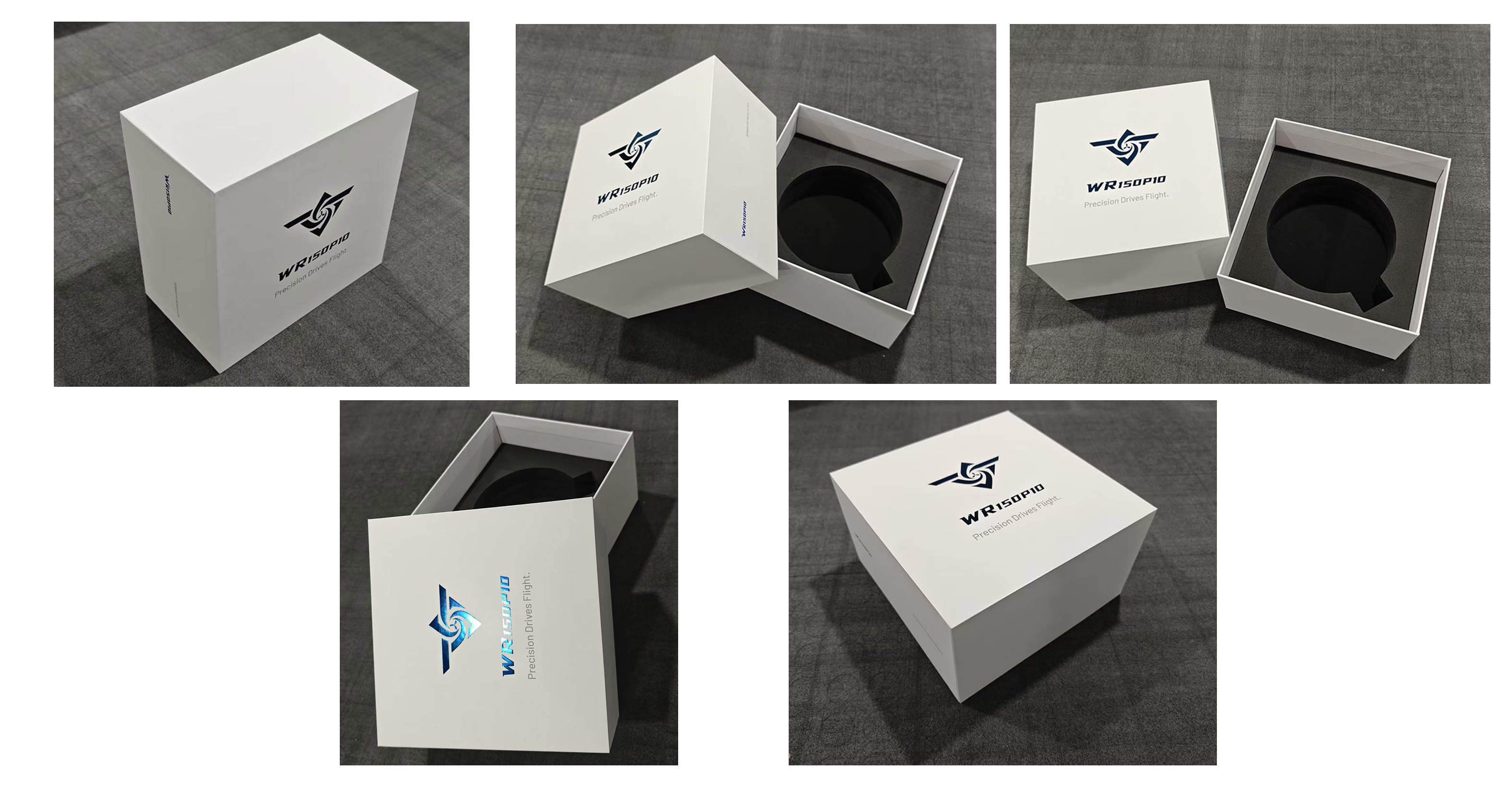
- Final solution: Telescope rigid gift box + custom EVA molded insert
- Sample lead time: 3–5 days
- Production lead time: 7–12 days
---
01 | When the client first came to us, the box had not been decided yet
The first message from the client was brief:
"We need a batch of packaging boxes for motor workpieces. The box should be rigid, the product should be fixed inside, around 500 pieces, send a sample first."
No design draft, no preferred box type, no specific dimensions.
What they did send was one product photo — a motor workpiece, front view, workshop bench in the background, with a caliper next to it.
This kind of brief is common in our line of work.
It is not that the client does not want to give details — they themselves have not figured it out yet. In their head there is only one outcome: "I want a box that protects the product, looks decent when taken out, and looks presentable." The middle part — which box type to pick, how to design the insert, how to match dimensions — they are waiting for the supplier to come up with.
But we do not jump straight into picking a box type.
---
02 | We did not look at the box type first, we looked at the motor workpiece first
Our standard process is: Confirm the product first, then determine the packaging.
This is not a slogan. It is there to avoid rework later.
That day, instead of discussing the box type, we asked the client to send us five things:
- The actual product or high-resolution photos (multiple angles, at least 4 sides + details of any protrusions)
- Three dimensions (length × width × height, accurate to mm)
- Net weight (including accessories)
- Handling method (how the client usually picks up the workpiece — with gloves? bare hands? with a tool?)
- Application scenario (sample testing? customer acceptance? trade-show display? business delivery?)
The client replied: "I measured the dimensions. Length 142mm, width 98mm, height 56mm, weight 780g. But there are a few protrusions and a terminal post on the workpiece, and I am worried they will get knocked during shipping."
That is enough for us to start.
In the seven days that followed, here is what we did:
| Step | What we did | What the client provided |
|---|---|---|
| Step 1 | Received the actual workpiece and made a 1:1 EVA trial mold based on the dimensions | Sent the actual product + terminal post position drawing |
| Step 2 | Trial-fit the product, confirmed cavity depth, buffer distance, removal direction | Video confirmation that the product can be taken out one-handed |
| Step 3 | Reverse-engineered the box type — because the product protrusions were at the top, the box needed 8mm internal-height allowance | Agreed to telescope rigid box + black EVA insert |
| Step 4 | Made a plain white sample, checked box rigidity, lid fit tightness, print effect | Received the sample, gave modification feedback |
| Step 5 | Fixed two minor issues (lid fit slightly tight + logo foil position fine-tuning), made the bulk-production sample | Signed off, production started |
---
03 | The truth about the 6-dimension fit: what really got us stuck was "EVA thickness × lid height"
On the product page we have talked about the 6-dimension coupling in a telescope rigid gift box —
product dimensions → EVA thickness → cavity depth → internal box height → lid height → closing compression relationship.
On this project, what really got us stuck was not the product dimensions, but how EVA thickness and lid height fit together.
Reason:
- The client's terminal post protruded 6mm above the workpiece surface
- The top of the workpiece needed buffer protection, and the EVA at the top had to keep a 4mm buffer gap
- Total top-side EVA footprint = 6mm (protrusion clearance) + 4mm (buffer) = 10mm
In other words, the minimum internal box height = workpiece height 56mm + top EVA 10mm + bottom EVA 6mm + handling clearance 4mm = 76mm.
But in our first quote to the client, we listed the internal box height as 72mm.
Off by 4mm.
If we had built it at 72mm, either the top EVA would have to be thinner (losing the protection on the protrusion), or the lid would not close (being pushed up by the workpiece, deforming over time).
Final solution: Internal box height set at 76mm, gray board upgraded to 1200g double gray board for rigidity, lid height tuned in sync for a smooth but non-wobbly close.
Had we not worked through all 6 dimensions and instead picked a box type directly from the client's initial "length 142, width 98, height 56", this project would have come out as a box that either would not close or would not let the product out.
---
04 | The 3 places where the client kept making changes
Real projects do not go right on the first pass.
During this project the client came back with three rounds of revisions:
Round 1: Should we line the inside of the lid with velvet?
"We would like the box to feel a bit more premium when you open it. Can we line the inside of the lid with a layer of velvet?"
We suggested sampling it first.
Result: with the velvet lining, the lid needed an extra 1.5mm of internal height, and the lid-close damping improved at the same time (the velvet friction kept the lid from snapping shut).
Conclusion: Keep the velvet, but bump internal height by another +1.5mm to 77.5mm, and thicken the gray board to 1500g double gray board in step.
The client accepted this revision.
Round 2: Logo foil stamping position
"Can the logo foil stamping be moved down by 3mm? Right now it is sitting on the lid seam, and it does not look clean."
We redrew the artwork, moved the logo down 3mm so the foil stamping landed cleanly on the lid face without crossing the seam.
Conclusion: Revision accepted, no extra charge.
Round 3: Initial quantity bumped from 500 to 800
"The trade-show feedback was good. The overseas team also wants to use this box. Add another 300."
We adjusted the price on the spot — at 800 pieces the unit price actually came out 8% lower than at 500 (the minimum-order threshold had been crossed).
Conclusion: Additional order accepted, no process changes needed.
Across these three rounds, the first one was a structural adjustment, the latter two were process and quantity.
For a supplier, the first one is where judgment is tested — recognizing that "the client is not asking for decoration, they are asking for feel," and turning a decorative upgrade into a structural upgrade.
---
05 | One sentence the client said at delivery
On the day the bulk shipment was delivered, the client sent us this message:
"This box makes our product look a class above the competition in front of our customers."
This is not just politeness.
What it means is that the motor workpiece used to be just a component in the customer's eyes. Now, with the packaging, the first impression has shifted from "component" to "product".
That is the most direct value premium industrial packaging can deliver — not the packaging itself, but the way the product is perceived.
---
06 | What this process is good for
Extracted from this project, the product types it fits are:
- Motor workpieces (servo motor, stepper motor, gearbox components)
- Precision machinery parts (bearings, gearboxes, couplings)
- Hardware fittings (standard parts, non-standard parts)
- Equipment fittings (sensors, controllers, modules)
- Industrial samples, trial-manufactured pieces
What it does not fit:
- Oversized products (box exceeding 400mm — shipping and cost go out of control)
- Overweight products (over 3kg per piece — telescope rigid box cost becomes prohibitive; recommend wooden or corrugated solutions instead)
- Highly irregular shapes (multiple combined EVA inserts needed — process lead time and cost climb significantly)
---
07 | If you have a similar product
If you have a motor workpiece, a precision part, or an industrial sample that needs packaging that protects the product, holds it in place, and adds points in front of the customer on delivery, you can send us three things first:
- The actual product or CAD drawing
- Workpiece dimensions + weight + key protrusion positions
- Initial quantity + application (sample testing / customer acceptance / trade-show / business delivery)
We can give you a free pre-assessment on:
- Whether a telescope rigid box is right (or whether a book-style box, drawer box, or corrugated solution fits better)
- How to choose EVA density (impacts buffer and cost)
- Which finishes are worth doing and which ones the customer would not notice
- How unit price works out at small-batch MOQ
- How to schedule sampling and bulk-production timelines
One line: We look at your product first, then we talk about your box.
---
08 | Other industrial packaging cases you might be interested in
Our industrial premium packaging work goes beyond motor workpieces. A few common sub-segments:
- Precision machinery parts premium telescope rigid box (EVA molded positioning + matte lamination finish)
- Heavy metal workpiece packaging solution (corrugated outer box + EVA inner lining + reinforced buffer structure)
- Industrial sample small-batch gift box (multi-SKU custom solution, single SKU starting from 200–500 pieces)
- Equipment fitting business delivery box (paired with brand logo foil stamping + full-color printing)
---
Final note: The difference between a case page and a product page
You are looking at the case page for this product.
On the product page, we talk about "what this packaging can do."
On the case page, we talk about "how we got this project right."
If you are making a packaging decision, the product page tells you what we can offer;
the case page tells you how we do it, what pitfalls we hit, and what the client says.
Read both, and your judgment will be more accurate than from either one alone.
📸 📸 Results Gallery
FAQ
What is the typical MOQ for premium packaging of motor workpieces?
Our telescope rigid box + custom EVA insert solution starts at 500 pieces. If the client places an additional order, the per-piece price at 800 pieces is actually about 8% lower than at 500 pieces — a critical-threshold effect.
My product has protrusions / terminal posts / irregular shapes. Can the packaging still protect it well?
Yes. The protrusion position is one of the key variables in packaging design. We typically work through all six dimensions (product dimensions → EVA thickness → cavity depth → internal box height → lid height → closing compression) one by one. For example, on this project the terminal post protruded 6mm, the top EVA had to reserve 10mm of buffer distance, and the internal box height was set to 77.5mm accordingly.
If it is only for sample testing, can a few hundred pieces still be done as premium packaging?
Yes. The essence of premium packaging is not the quantity, it is the right structural selection + custom insert + finish matching. This project started at 500 pieces. The per-box cost is a bit higher than bulk production, but only slightly more than a regular corrugated box — and the client's sample is perceived as a product in front of the customer. That is the value of premium industrial packaging.
Need a Similar Packaging Solution?
Provide product info and packaging needs for a custom solution