
Color Box Packaging Solution for Multi-Spec Metal Parts Transport Protection of an Industrial Manufacturer
Client Requirements
Client Requirements and Issues with the Original Solution
The client's existing packaging method had high management costs.
The carton plus filler approach required a custom inner liner for each product.
With more than 5 specifications, inner-liner management became chaotic.
Filler shifted during transport, causing metal parts to collide and get scratched.
Return rate was high.
The client wanted to reduce management complexity through a unified packaging solution.
While ensuring transport protection for different products.
The first batch was limited in quantity, and traditional plate-based printing costs were high.
Core requirements: multi-spec adaptation + transport protection + simplified packaging management.
Project challenges:
✓ Many product specifications (more than 5) with large differences in size and weight
✓ Filler shifting caused parts to collide and get scratched during transport
✓ Limited first-batch quantity meant plate-making costs were relatively high
✓ A solution was needed to fit multiple specifications
Solution
Solution Overview
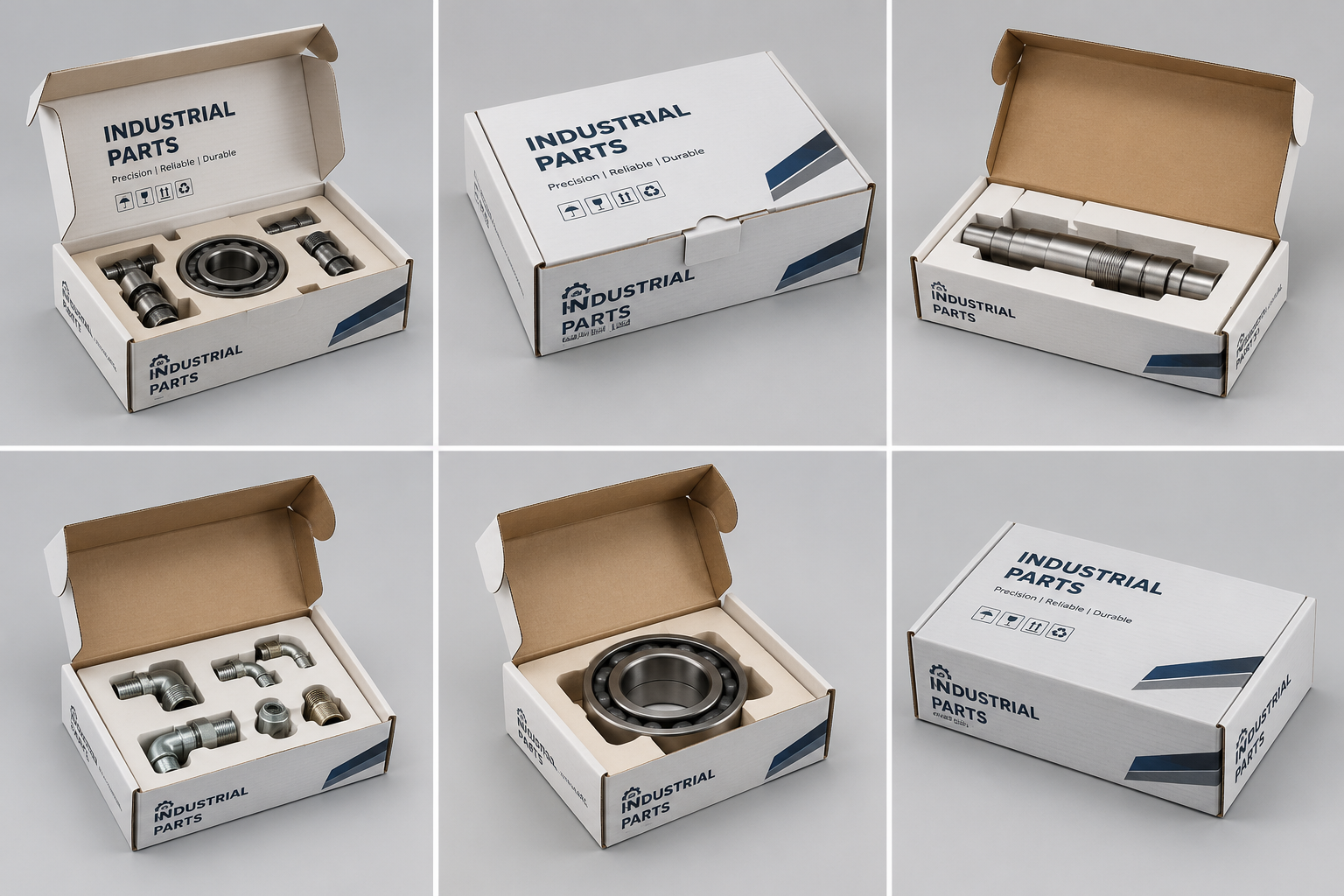
Provided the client with an integrated color-box + paper-card inner tray solution for 5 specifications of metal parts.
The color box uses a crash-bottom box or airplane box structure.
Inside the box, 350g paper-card die-cut inner trays are configured.
The inner trays are precision-slotted to the part profile.
Parts are fixed in the inner tray slots and will not shift or collide during transport.
Material Selection Analysis
Why paper-card inner tray instead of foam filler?
Paper-card inner trays are precision-slotted to the part profile.
Each part has an independent fixed position.
Parts do not shift during transport, avoiding collision and scratches.
Paper card can be die-cut together with the box body, with no separate minimum-order quantity.
Why not foam or EVA inner trays?
Foam or EVA inner trays are plastic products.
This case is positioned in the direction of paper-based packaging.
Paper-card inner trays fit protection performance and material direction better.
Why not the traditional carton plus filler approach?
Carton plus filler has high management costs.
With more than 5 specifications there are many filler variants, and management becomes chaotic.
Paper-card inner trays are produced together with the box and need no separate management.
Production Implementation and Quality Control
① Size measurement and inner-tray slot design for the 5 part specifications
② Color-box structure design (crash-bottom box or airplane box)
③ Incoming inspection of full-white F-flute corrugated
④ Four-color printing
⑤ Matte film lamination (25μ)
⑥ Die-cutting (color box + paper-card inner tray die-cut in one pass)
⑦ Creasing and forming
⑧ Sampling inspection (inner tray slot precision, color-box compression)
⑨ Sorted by specification and shipped
Results
Project Results
Delivery Data
✓ Products delivered: 5 specifications of metal parts color boxes + paper-card inner trays
✓ Color box material: full-white F-flute corrugated (2.0mm)
✓ Inner tray material: 350g paper-card die-cut
✓ Printing method: four-color printing
✓ Quantity delivered: 5 specifications, total 800 sets
✓ Lead time: 4 working days
Usage Performance
✓ Client feedback: collision-and-scratch rate during transport dropped
✓ All 5 specifications managed in one system; no separate inner-liner stock needed
✓ Return rate decreased
Case Summary
For multi-spec metal-part transport packaging.
Replacing traditional filler with paper-card inner trays is a common path to simplify management and improve protection.
This case delivered an integrated color-box + paper-card inner tray solution for 5 specifications of metal parts of an industrial manufacturer.
Paper-card inner trays are precision-slotted to the part profile.
Parts stay fixed and do not shift.
LeXiang Packaging Experience
Applicable scenarios: multi-spec metal-part transport packaging. Precision parts that must avoid transport collision and scratches. Unified-management industrial consumable packaging.
Material recommendations: regular 1-2kg parts — choose full-white F-flute corrugated (2.0mm) + 350g paper-card inner tray. Lightweight parts — full-white E-flute is an option. Heavy parts — recommend double-wall corrugated.
Non-applicable scenarios: not suitable for scenarios requiring cushioning performance, such as glassware. Not suitable for irregularly shaped parts, where paper-card slotting costs are high.
Notes: paper-card inner tray slot precision must match part dimensions. For multi-spec management, we recommend a unified box structure and only swap inner-tray slot design. Transport protection performance needs verification in actual transport tests.
Why Choose LeXiang Packaging
✓ One-stop delivery of multi-spec metal-part transport color boxes plus paper-card inner trays
✓ Corrugated color boxes tested to GB/T 4857.4 transport vibration standards
✓ Industrial color boxes configured with double-wall corrugated for the client's stacked-storage scenarios
✓ Multi-spec synchronous proofing for metal-part transport color boxes saves plate costs
Why Choose LeXiang Packaging
✓ One-stop delivery of multi-spec metal-part transport color boxes plus paper-card inner trays
✓ Corrugated color boxes tested to GB/T 4857.4 transport vibration standards
✓ Industrial color boxes configured with double-wall corrugated for the client's stacked-storage scenarios
✓ Multi-spec synchronous proofing for metal-part transport color boxes saves plate costs
Related Reading
Industry-related (by material/process similarity):
An industrial automation company: multi-model variable ...
An industrial manufacturer: large machinery safety ...
An industrial manufacturer: outdoor equipment weather-resistant ...
An industrial manufacturer: multi-SKU product ...
A food e-commerce brand: new-product small-batch color ...
Project Metrics
Project Overview
Industry: Industrial (metal parts manufacturing)
Product: Multi-spec metal-parts color boxes + paper-card inner trays
Quantity: 5 specifications, total 800 sets | Variants: 5 part specifications
Material: Full-white F-flute corrugated (2.0mm) + 350g paper-card inner tray
Process: Four-color printing, matte film lamination, die-cutting, creasing
Lead time: 4 working days (after artwork confirmation)
Client Background and Application Scenario
An industrial manufacturer produces multiple specifications of metal parts.
Product specifications include small metal items such as bolts, nuts, and washers.
Products require matching color boxes as inner packaging when leaving the factory.
The color boxes must be configured with paper-card inner trays to fix the parts.
Transport scenarios include road and rail transport.
End customers are mostly industrial assembly companies.
📸 📸 Results Gallery
FAQ
What is the minimum order quantity for industrial parts packaging boxes?
Crash-lock bottom boxes and airplane boxes have a small-batch minimum order of 50-100 sets. Paper card inserts are die-cut together with the box body, with no separate minimum order quantity.
Metal parts are relatively heavy—can a crash-lock bottom box support the weight?
The self-locking bottom structure of the crash-lock bottom box provides stable load-bearing capacity. All-white F-flute paperboard can support metal parts within 1-2kg. For parts over 2kg, double-layer corrugated is recommended.
Can paper card inserts replace foam fill materials?
For standard-shaped metal parts, yes, they can replace foam. Paper card inserts feature precise slots cut to the part outline, ensuring parts do not shift during transport.
Are there color accuracy requirements for industrial color boxes?
Yes. For multi-batch printing, color variation must be controlled within the customer's acceptance range. It is recommended to provide sealed samples for comparison and Pantone color codes.
What is the typical lead time for industrial packaging boxes?
Sampling takes 3-5 working days. Mass production takes 5-7 working days. The specific timeline depends on the number of specifications and process complexity.
How accurate is the slot precision of paper card inserts?
Die-cutting precision can reach ±0.5mm. After measuring part dimensions, slots are designed to match the outline, ensuring a precise fit.
How is the compression test conducted for industrial color boxes?
Typically evaluated per transport packaging test standards such as GB/T 4857.4 or ISTA 1A. The specific test plan is jointly confirmed by the customer and the certification body.
What box styles are available for industrial packaging boxes?
Common box styles include crash-lock bottom boxes, airplane boxes, double-insert boxes, self-sealing boxes, and more. The specific choice depends on product dimensions and opening method.
Can paper card inserts be reused?
Paper card inserts are single-use packaging materials. If reuse is required, EVA or blister inserts are recommended instead.
What transport tests are included for industrial packaging boxes?
Common tests include vibration testing, impact testing, stacking testing, and drop testing. The specific test plan is executed as jointly confirmed by the customer and the certification body.
Need a Similar Packaging Solution?
Provide product info and packaging needs for a custom solution