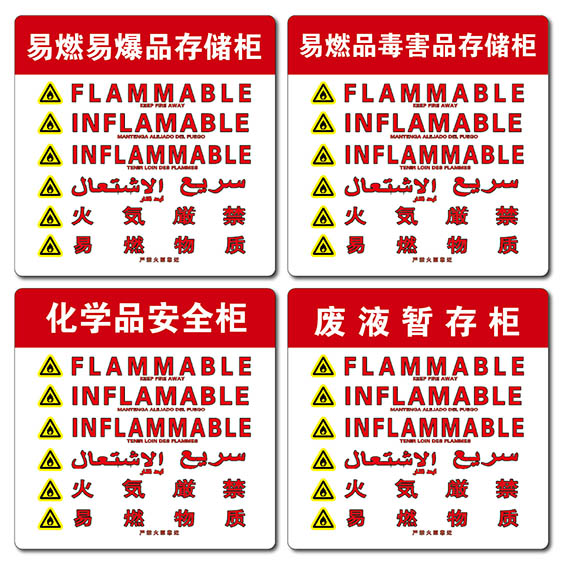
PVC Safety Identification Label
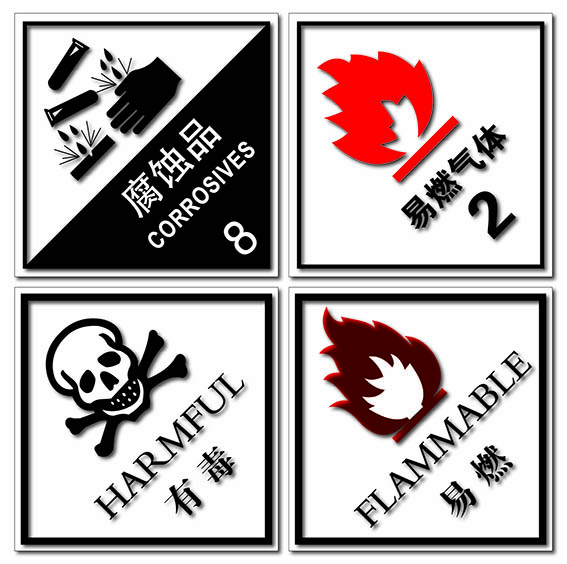
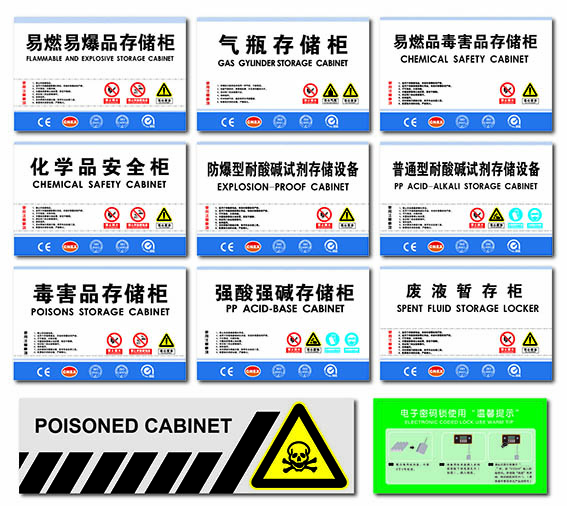
0.38mm rigid PVC safety label with high visibility on safety cabinets. High-precision color printing with UV-resistant ink for long-lasting indoor/outdoor color stability. 3M double-sided adhesive on the back for firm bonding on metal, glass, stainless steel, and powder-coated surfaces. Ideal for chemical safety cabinets, waste-liquid cabinets, flammable/explosive cabinets, toxic-substance storage, and laboratory/hazardous-chemical areas. Size, graphics, and content fully customizable.
📸 📸 Product Images
FAQ
Why use 0.38mm thick PVC instead of a standard self-adhesive label?
0.38mm thick PVC offers superior stiffness and a strong three-dimensional effect, making the label more prominent once mounted. It is also more wear-resistant and durable, with a service life far longer than that of ordinary paper labels.
Can this product be used outdoors long term?
Yes. The product is printed with UV-resistant ink and offers water- and moisture-resistance, allowing it to handle long-term indoor use and general outdoor environments without fading under normal conditions.
Does the 3M double-sided adhesive hold firmly?
High-quality 3M high-tack double-sided adhesive is used, providing excellent bonding on metal, powder-coated cabinets, stainless steel, glass, and acrylic surfaces, and is not prone to lifting or detachment.
Can the safety label content be customized?
Yes. We support custom safety label content for chemical safety cabinets, waste-liquid storage cabinets, flammable/explosive material cabinets, toxic-substance storage cabinets, corrosive-material cabinets, gas-cylinder cabinets, and more. Corporate logos, QR codes, serial numbers, and multi-language versions are also supported.
Is the product waterproof and resistant to alcohol wiping?
The PVC material provides good waterproof performance, allows routine cleaning, and withstands standard alcohol wiping (avoid prolonged soaking or use of strongly corrosive solvents).
Do you support small-batch customization?
Yes. Sample production, small-batch production, and bulk delivery are all available to meet the needs of laboratories, hospitals, schools, factories, and hazardous-chemical management customers.
📖 📖 More Details
Both quote sheets say "PVC safety identification label"—so why can the prices differ by 2–3x?
A buyer receives three quotes: Supplier A at 1.8 yuan/piece, Supplier B at 3.2 yuan/piece, and Supplier C at 5 yuan/piece. All three list PVC, self-adhesive, color printing, and waterproof. On paper they look identical—so what is actually different?
This case study is not about a single product. It is about what a buyer should really be looking at when facing this kind of quote.
"Print clarity" and "long-term clarity" are two completely different questions
Whether an industrial identification label can stay on site long term depends not on whether it looks sharp on day one, but on whether it still looks sharp six months, one year, or two years later.
The difference between the two comes down to five dimensions: material thickness, ink grade, surface treatment, adhesive type, and operating environment. The combination of these five is the true cost of a label—the word "PVC" on a quote sheet alone tells you nothing about whether the sticker will survive the field.
When a customer asks for "PVC labels," we first ask 7 questions
The customer's first sentence is usually "I want PVC, give me a quote"—but we don't reply with a price immediately. We ask seven questions first.
① Where will it be applied—cabinets, pipes, equipment, or walls?
② Indoor or outdoor—is it exposed to sun and rain?
③ How long must it last—3 months, 1 year, or long term?
④ What is the substrate material—metal, plastic, glass, or powder-coated?
⑤ Will it be cleaned frequently—regular wiping or disinfection?
⑥ Will it contact chemicals—acids, alkalis, solvents, or oils?
⑦ Does it need a QR code, serial number, or multi-language text?
Only after these seven questions are answered can we decide: whether the label should use PVC, PET, synthetic paper, or another industrial label stock; what grade of ink to use; and which adhesive model to specify.
The real situation behind this case
The customer for this PVC safety identification label needed labels for chemical safety cabinets. Rather than producing it as a generic self-adhesive label, we matched the cabinet surface and operating environment and delivered a 0.38mm rigid PVC identification label.
The original request was simply "make it in PVC"—but after the seven questions, the real situation was: powder-coated steel cabinets, indoor use, regular cleaning-agent wiping, long-term use (at least 2 years), and QR-code traceability required. Standard self-adhesive or thin PVC would have failed in this environment—the adhesive would lift and the print would blur. Rigid PVC paired with the right adhesive model is what stays stable.
Why rigid PVC instead of ordinary PVC
Common industrial label materials fall into three tiers:
Standard paper labels: work short term, but curl and fade over time—suitable for temporary marking or short-term indoor use.
Standard (thin) PVC: better water and UV resistance than paper, but gradually becomes brittle and shifts in color over time—suitable for medium-term use.
Rigid PVC (0.38mm or thicker): strong three-dimensional feel, deformation-resistant, and more stable long term—suitable for long-term use or labels that must remain highly legible.
These three tiers are not "the thicker the better"—they are matched to the operating environment and service life. Which tier to choose is decided by the answers to the seven questions above.
Adhesive selection is not just about "sticks firmly"
Whether a label stays on the cabinet long term depends on more than whether the adhesive "sticks firmly." Even with the same high-tack adhesive, performance differs on powder-coated steel, stainless steel, and glass.
Adhesive selection must consider: substrate characteristics + adhesive type + application surface + operating environment. Only when these four match does the adhesive truly hold; if they don't match, even a strong adhesive can lift or detach within a few months.
The final confirmed solution for this case
The final confirmed solution for this PVC safety identification label:
Material: 0.38mm thick rigid PVC
Printing: High-precision color printing
Ink: Weather-resistant ink
Adhesive: 3M high-performance high-tack double-sided tape
Finish: UV- and abrasion-resistant
Application: Metal cabinets / glass / stainless steel / powder-coated cabinet bodies and other surfaces
MOQ: 50 pieces
Lead time: 3–7 working days
Not sure what material your industrial label needs?
Send us the answers to the seven questions above (where it will be applied / indoor or outdoor / service life / substrate material / cleaning exposure / chemical exposure / whether QR codes are needed)—and we can help you judge whether PVC, PET, synthetic paper, or another industrial label stock is the right fit.
Let LeXiang help you decide which material to use
You may also be interested in these industrial label cases
If you are working on industrial on-site labels, equipment nameplates, or pipe markers, here are several other real cases we have completed that you can review together:
· Pipe labels / pipe identification stickers / pipe flow-direction labels—3M outdoor weather-resistant labels for chemical plants / mines / aggregate plants in outdoor environments
· More industrial label applications—equipment nameplates, warning labels, warehouse signage, and similar scenarios are continually being added.
These cases share the same industrial on-site context as this one—all are real industrial label projects involving 3M material selection, adaptation to different substrate surfaces, and long-term stability in the field.
Need a Custom Packaging Solution?
Submit your needs for a professional quote and production advice