
Safety Warning Label Solution for Large Industrial Machinery
Client Requirements
Client Requirements and Issues with the Original Solution
The client's existing labels used coated-paper self-adhesive.
Durability in industrial environments was insufficient.
The coated-paper face material lacked oil and moisture resistance.
After about 3 months, edge lifting and image-text wear appeared.
What made it worse.
Different equipment models had different warning content.
Warning, prohibition, and mandatory signs all had distinct content.
Multi-version small-batch production was required.
The client required that labels maintain adhesion and legibility over the long term.
In environments with oil, moisture, and large temperature swings.
Warning colors needed to be eye-catching and comply with applicable safety-marking regulations.
Core requirements: durability + multi-version flexible production + compliant safety colors.
Project challenges:
✓ Equipment is in long-term contact with cutting fluid and lubricants; ordinary materials are not durable
✓ Different equipment models need different warning content; many versions
✓ Warning colors (safety yellow, safety red) must meet standards
✓ Small-batch, multi-version: traditional plate-making costs are high
Solution
Solution Overview
Provided the client with a PVC self-adhesive safety warning label solution.
Combined with an oil-resistant permanent acrylic adhesive and a matte film protective layer.
Digital printing enables flexible switching of multi-version content at zero plate cost.
Warning colors are mixed with spot color to ensure color purity meets GB 2893.
Material Selection Analysis
Why PVC self-adhesive instead of coated paper?
Coated-paper labels in oily and moist environments.
Paper fibers absorb oil and water and lose strength.
After about 3 months, edge lifting and image-text wear appear.
PVC face material is oil-resistant and moisture-resistant.
Even when equipment is exposed long-term to lubricants or coolant, it does not easily bubble, deform, or delaminate.
80μ PVC conforms well when applied to curved equipment surfaces and does not lift at corners.
Why not keep using coated paper?
Coated paper performs acceptably in dry, clean office environments.
But in manufacturing workshop environments.
Cutting-fluid oil mist and wet wiping during operator cleaning accelerate label aging.
Coated paper has a service life of less than 3 months in oily environments.
Frequent label replacement affects equipment maintenance efficiency.
Why not PET labels?
PET (50μ) does have stronger chemical resistance.
But PET material is relatively rigid, and edges tend to lift when applied to curved equipment shells.
And PET costs about 30-50% more than PVC.
For indoor-equipment warning labels, PVC performance is sufficient.
Production Implementation and Quality Control
① Warning content compiled per model
② Color calibration (safety yellow / safety red spot-color mixing)
③ Digital printing (each version output independently)
④ Matte film lamination (25μ)
⑤ Die-cutting and waste stripping
⑥ Slitting and rewinding
⑦ Sampling inspection (color density, dimensions, die-cutting precision)
⑧ Sorted by model and shipped
Results
Project Results
Delivery Data
✓ Products delivered: industrial-equipment safety warning labels (PVC + matte film)
✓ Material specification: PVC self-adhesive 80μ + oil-resistant permanent adhesive + matte film 25μ
✓ Version count: multiple warning-content versions delivered simultaneously per model
✓ Printing method: digital printing + spot color mixing
Usage Performance
✓ After application, labels bond firmly; no fading or detachment in simulated industrial environments
✓ Warning markings have clear, eye-catching colors that meet safety-marking requirements
✓ Different model label content is clearly distinguished
Case Summary
Material selection for industrial-equipment safety warning labels must consider the long-term oily, moist, and temperature-varying environment of the equipment.
This case uses 80μ PVC self-adhesive face material, combined with an oil-resistant permanent adhesive and a 25μ matte film lamination solution.
Replacing the original coated-paper labels.
PVC face material does not absorb water or deform in oily and moist environments.
The laminate layer provides physical protection and reduces oil adhesion.
Digital printing enables differentiated warning content per model to be output in the same batch at zero plate cost.
LeXiang Packaging Experience
Applicable scenarios: industrial-equipment warning labels, labels in oily and moist environments, multi-version small-batch
Material recommendations: regular industrial environments — choose PVC (80μ) + matte film.
Outdoor or high-temperature environments — choose PET (50μ).
Clean environments — coated paper can be chosen to reduce cost.
Non-applicable scenarios: not suitable for scenarios requiring resistance to strong solvents (such as acetone) — recommend PET.
Not suitable for food-contact surfaces (food-grade material required).
Notes: equipment surface oil must be cleaned before application.
To ensure firm bonding.
For safety warning colors, we recommend using Pantone codes to ensure color standardization.
Professional Knowledge
GB 2893 "Safety Colors" requirements for warning colors
Safety colors are colors used to convey safety information such as prohibition, warning, mandatory, and indication.
GB 2893 specifies the colorimetric properties of safety colors.
Safety red is used for prohibition, stopping, and danger signals.
Safety yellow is used for warning and caution.
Safety blue is used for mandatory actions and rules that must be observed.
Safety green is used for indication, safe state, and passage.
PVC vs coated paper vs PET — how to choose?
Coated paper: lowest cost.
Suited to dry, clean office or commercial environments.
Oil and moisture in industrial environments accelerate aging.
PVC: oil-resistant,
water-resistant,
and flexible.
Suited to indoor industrial environments and metal-equipment surfaces.
80μ thickness performs well on curved surfaces.
PET: resistant to chemical solvents,
high temperatures (-40°C to 150°C),
and outdoor UV.
High rigidity and weak curved-surface conformability.
Suited to flat or outdoor scenarios.
Why Choose LeXiang Packaging
✓ PVC face material at 80μ paired with 25μ matte film lamination; weather-resistance tested to GB/T 16260
✓ Large-machinery safety warning labels checked against the GB 2893 safety-color standard
✓ Multi-model safety warning labels managed in a unified way per client visual specifications
✓ PVC labels with permanent acrylic adhesive bond firmly; no edge lifting for 3+ years
Why Choose LeXiang Packaging
✓ PVC face material at 80μ paired with 25μ matte film lamination; weather-resistance tested to GB/T 16260
✓ Large-machinery safety warning labels checked against the GB 2893 safety-color standard
✓ Multi-model safety warning labels managed in a unified way per client visual specifications
✓ PVC labels with permanent acrylic adhesive bond firmly; no edge lifting for 3+ years
Related Reading
Industry-related (by material/process similarity):
An industrial manufacturer: outdoor equipment weather-resistant ...
An industrial manufacturer: multi-SKU product ...
An industrial automation company: multi-model variable ...
An industrial manufacturer: multi-spec metal ...
An industrial parts exporter: multi-language ...
Project Metrics
Project Overview
Industry: Industrial (large machinery manufacturing)
Product: Large machinery safety warning labels
Quantity: multi-version × tens to hundreds per model | Variants: distinct warning content per version
Material: PVC self-adhesive (80μ) + oil-resistant permanent adhesive + matte film 25μ
Process: Digital printing + matte film lamination + die-cutting
Lead time: 3 working days (after artwork confirmation)
Client Background and Application Scenario
An industrial manufacturer produces large machinery.
Safety warning markings must be applied before equipment leaves the factory.
Equipment types cover metal-processing machines, automated production lines, and dedicated machine tools.
Warning markings include warning signs, prohibition signs, and mandatory signs.
Equipment operates long-term in cutting-fluid, lubricant, and high-moisture environments.
The original coated-paper warning labels faded, edge-lifted, or even detached within about 3 months.
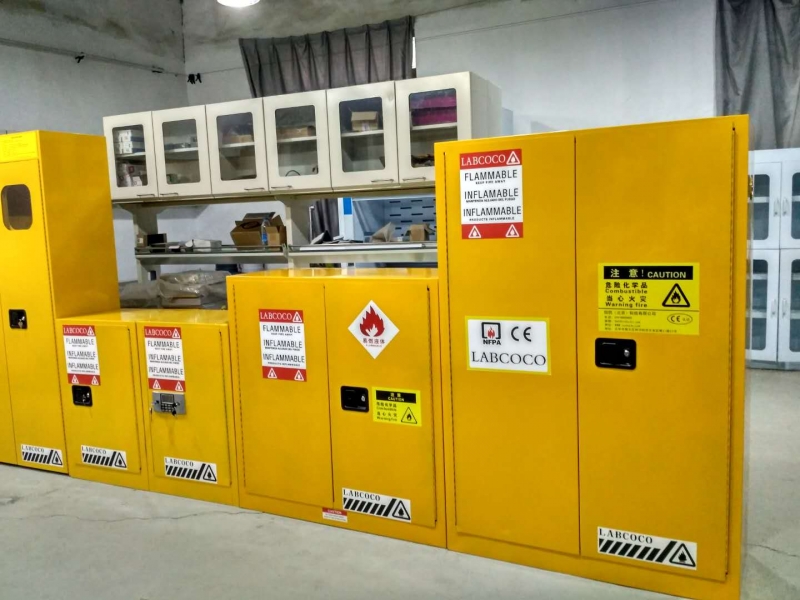
📸 📸 Results Gallery
FAQ
What is the minimum order quantity for safety warning labels?
PVC self-adhesive labels can be ordered from 1 roll, with multiple versions consolidated into one production run. Warning content for different models can be laid out in the same artwork file, and the total order quantity is calculated according to the total number of labels.
Are PVC labels suitable for metal surfaces?
Yes. PVC self-adhesive material with durable adhesive provides good adhesion to metal surfaces, including cold-rolled steel, stainless steel, and aluminum. Clean oil and contaminants from the surface with alcohol before application.
What standards apply to the colors of safety warning labels?
Safety sign colors must comply with GB 2893, Safety Colours. The standard specifies the color coordinates for safety yellow (warning) and its recommended background contrast color, as well as safety red (prohibition). LeXiang can formulate custom colors according to Pantone color codes.
What temperature range can PVC labels withstand?
The standard temperature resistance of 80μ PVC self-adhesive material is -20°C to 80°C. If the equipment surface temperature exceeds 80°C, PET labels are recommended for evaluation, with a temperature resistance of -40°C to 150°C.
How much longer do laminated labels last than unlaminated labels?
Laminated labels generally last 2-3 times longer than unlaminated labels. The overlaminate provides a protective layer against abrasion, oil, and moisture. Lamination is recommended for industrial equipment warning labels.
How should the material for safety warning labels be selected?
For conventional industrial environments, choose PVC (80μ) + matte overlaminate. For outdoor or high-temperature environments, choose PET (50μ). In clean environments, coated paper can be selected to reduce costs.
What content can warning labels include?
Common content includes warning signs, prohibition signs, mandatory action signs, and safe-condition signs. The specific content must be confirmed by the customer’s regulatory and safety teams.
How many adhesive options are available for PVC labels?
Durable acrylic adhesive is commonly used for PVC self-adhesive labels. Oil-resistant adhesive can be selected for oily environments, while low-temperature adhesive is suitable for low-temperature environments.
What is the typical lead time for warning labels?
Digital proofing takes 1-2 working days. Mass production takes 3-5 working days. The specific lead time depends on the number of versions and process complexity.
How should the adhesive material for safety warning labels be selected?
Use conventional 80μ PVC face material with durable acrylic adhesive. Oil-resistant adhesive can be selected for oily environments, while low-temperature adhesive is suitable for low-temperature environments below -20°C. Material specifications are checked against the GB 2893 safety color standard.
Need a Similar Packaging Solution?
Provide product info and packaging needs for a custom solution