
Multi-Model Variable Data Barcode Label Solution for an Industrial Automation Company
Client Requirements
Client Requirements and Issues with the Original Solution
The client's existing labels used pre-printed production.
Each model was plate-made and printed in its own batch, switching models required re-plate-making, and the plate cost was fixed.
After the product line expanded to dozens of models.
Plate cost and plate-making lead time kept accumulating.
More thorny:
Different models had wildly different demand volumes.
Some models needed over a thousand labels at a time, others only dozens.
Traditional printing could not flex to this demand elasticity.
The client wanted a way.
To flexibly switch the barcodes of different models without changing plates.
While ensuring barcode readability and print clarity.
Core requirements: multi-model variable data + barcode readability + flexible small-batch production.
Project challenges:
✓ Multiple models required different barcodes and serial numbers, traditional plate-making could not flexibly switch
✓ Small barcode size put high demands on print precision and readability
✓ Labels had to adhere to equipment outer surfaces, with requirements for adhesion and durability
✓ Demand fluctuated significantly, some models needed very small top-up batches
Solution
Solution Overview
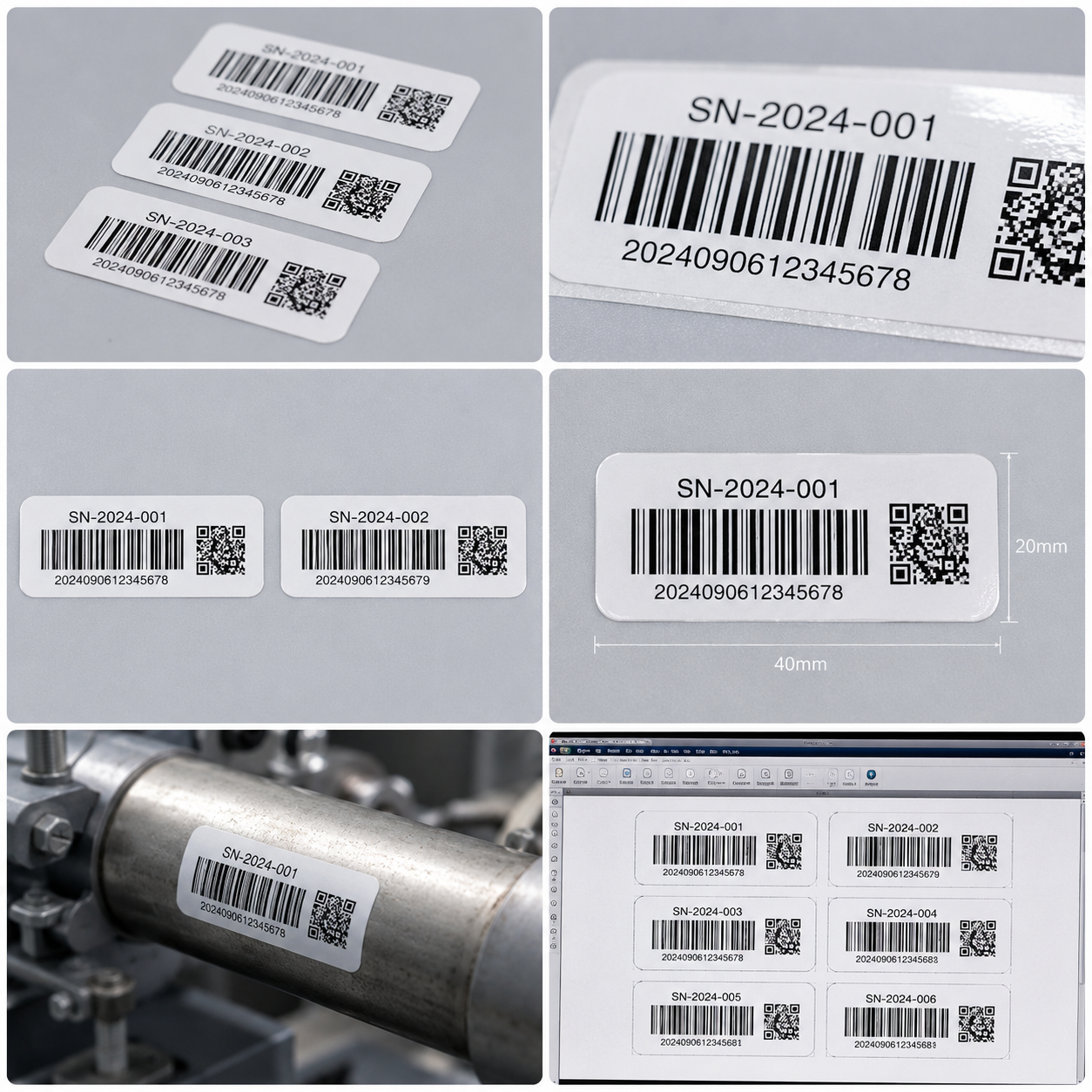
Delivered a variable-data barcode label solution for the client's 8-model industrial equipment line.
Used digital printing + variable-data technology.
Different models' barcodes, serial numbers, and QR codes were output within the same batch.
Switching models only required updating the data file, no plate-making needed.
Material Selection Analysis
Why digital printing?
Digital printing supports sheet-by-sheet independent content output.
Barcodes, serial numbers, and QR codes could be managed as independent variable fields in the file.
Digital printing requires no plate-making. Switching models means zero plate cost.
Why not traditional pre-printing?
Pre-printing requires a separate plate for each model.
Once the model count expanded from a handful to dozens, the accumulated plate cost was high.
And small-batch top-ups required re-plate-making, with long lead times.
Why not laser marking?
Laser marking is direct marking on the equipment housing.
Suited to metal housings.
But self-adhesive labels are a better fit for plastic housings or scenarios requiring quick marking changeover.
Production Implementation and Quality Control
① Encoding rules and data file organization for each model
② Variable-data layout (model + serial number + QR code + production date)
③ Digital printing (barcode-readability sampling inspection)
④ Matte-film lamination (25μ)
⑤ Die-cutting (including waste stripping)
⑥ Sampling inspection (barcode readability, print clarity, die-cutting precision)
⑦ Sort packing and shipping by model
Technical Notes
Key points in implementing variable-data labels
Data file management is the core.
Each model's serial-number range and starting value must be pre-set in the file.
During printing the system auto-increments within the range.
Multiple barcode formats are supported.
Common ones include Code128, Code39, EAN13.
Plus DataMatrix and QR Code.
Factors affecting barcode readability
Barcode readability depends on three elements.
First, barcode size and precision.
Second, print contrast.
Third, tolerance of the scanning device.
Digital printing typically outperforms traditional printing in precision on small-size barcodes.
Results
Project Results
Delivery Data
✓ Delivered product: 8-model industrial equipment barcode + serial-number labels
✓ Material specification: coated-paper self-adhesive + matte film 25μ
✓ Print method: digital printing + variable data
✓ Delivered quantity: 8 models totaling 6,000 labels
✓ Delivery cycle: 3 working days
Usage Effect
✓ Client scanning tests confirmed barcode readability across all models met the standard
✓ Subsequent small-batch top-ups went straight to production with zero plate cost
✓ Clear differentiation of label content between models
Case Summary
For barcode label production on multi-model industrial equipment.
Digital printing + variable data is a common path for replacing traditional pre-printing.
This case delivered a variable-data barcode label solution for 8 models of an industrial automation equipment enterprise.
Different models' barcodes and serial numbers were output in the same batch.
Switching models with zero plate cost.
Subsequent small-batch top-ups went straight to production.
LeXiang Experience
Applicable scenarios: multi-model industrial-equipment barcode labels. Serial-number markings requiring variable data. Product lines with frequent subsequent small-batch top-ups.
Material recommendations: standard indoor industrial equipment uses coated-paper self-adhesive + matte film lamination. Oil-contaminated environments use PVC (80μ). Outdoor scenarios use PET (50μ).
Non-applicable scenarios: not for scenarios requiring long-term resistance to strong solvents. PET is recommended. Also not for product markings that come into direct contact with food or pharmaceuticals.
Cautions: barcode readability is affected by print precision and contrast. Recommend providing a sample sheet for scan testing before batch production. The starting value and range of variable data need to be pre-defined to avoid duplicate or missing numbers.
Why Choose LeXiang
✓ Delivered 8 SKUs totaling 4,800 industrial variable-data barcode labels
✓ Digital printing supports dual symbology with GS1-128 1D barcode plus Data Matrix 2D code
✓ Barcode tested with scanner gun, measured read rate ≥ 99% (10 consecutive scans)
✓ Standardized management of multi-SKU file version numbers, reduction in missed version updates
Why Choose LeXiang
✓ Delivered 8 SKUs totaling 4,800 industrial variable-data barcode labels
✓ Digital printing supports dual symbology with GS1-128 1D barcode plus Data Matrix 2D code
✓ Barcode tested with scanner gun, measured read rate ≥ 99% (10 consecutive scans)
✓ Standardized management of multi-SKU file version numbers, reduction in missed version updates
Related Reading
Industry-related (by material/craft similarity):
Industrial manufacturer outdoor equipment weather-resistant...
Industrial manufacturer large machinery equipment...
Industrial manufacturer multi-SKU product...
Industrial manufacturer multi-spec metal parts...
Industrial parts exporter multi-language...
Project Indicators
Project Overview
Industry: Industrial (automation equipment manufacturing)
Product: multi-model industrial equipment barcode + serial-number self-adhesive labels
Quantity: 8 models totaling 6,000 labels | Categories: 8 barcode contents
Materials: coated-paper self-adhesive + matte film 25μ
Craft: digital printing, variable data, die-cutting
Lead time: 3 working days (after file confirmation)
Client Background and Application Scenario
An industrial automation equipment manufacturer produces multiple models of industrial sensors and control modules.
Products leave the factory with identification labels affixed to the equipment housing.
The labels need to include the product model, batch number, production date, and unique serial number.
Some high-end models also need to include QR code information that can be read by scanning.
Label demand varies significantly between different production batches.
📸 📸 Results Gallery
FAQ
Can the barcode content on industrial barcode labels be customized?
Yes. Barcode content is generated based on the customer's encoding rules. Formats supported include Code128, Code39, EAN13, DataMatrix, QR Code, and more.
How are serial numbers generated on the labels?
Serial numbers are automatically incremented by the system within predefined ranges during printing. No manual numbering of each piece is required.
What is the minimum order quantity for variable data labels?
With digital printing, production can start from a few dozen labels. Zero plate-making fees make it friendly for small batches.
Can the size of barcode labels be customized?
Yes. Label sizes are customized according to the adhesive area on the equipment housing. Standard industrial label sizes range from 30-100mm.
How is the barcode recognition rate of digital printing?
Digital printing offers high precision on small-size barcodes. It is recommended to provide a proof for scanning tests before mass production, then proceed with batch production once the recognition rate meets the standard.
What if a replenishment order is needed later?
With digital printing, replenishment orders have zero plate-making fees. Simply provide the new data file for direct production. The lead time is the same as the initial batch.
Can variable data labels include QR codes?
Yes. QR code content can include fields such as serial number, model, and production date. Scanning jumps to a custom link.
How to choose the material for barcode labels?
Coated paper for standard indoor use. PVC for oily environments. PET for outdoor scenarios. The choice depends on the equipment usage environment.
What adhesive is typically used for industrial labels?
Permanent adhesive (for lasting adhesion) is typically used for standard industrial equipment. Rubber-based adhesive can be selected if the identification needs to be replaced periodically.
What is the typical lead time for labels?
Digital proofing takes 1-2 working days. Mass production takes 3-5 working days. Specific lead time depends on quantity and process complexity.
Need a Similar Packaging Solution?
Provide product info and packaging needs for a custom solution